Why Secure File Transfer Is Becoming Part of Every AI Strategy
Why AI projects need production-ready secure file transfer paths for reliable data delivery, authenticated connections, encryption, and audit-ready evidence.
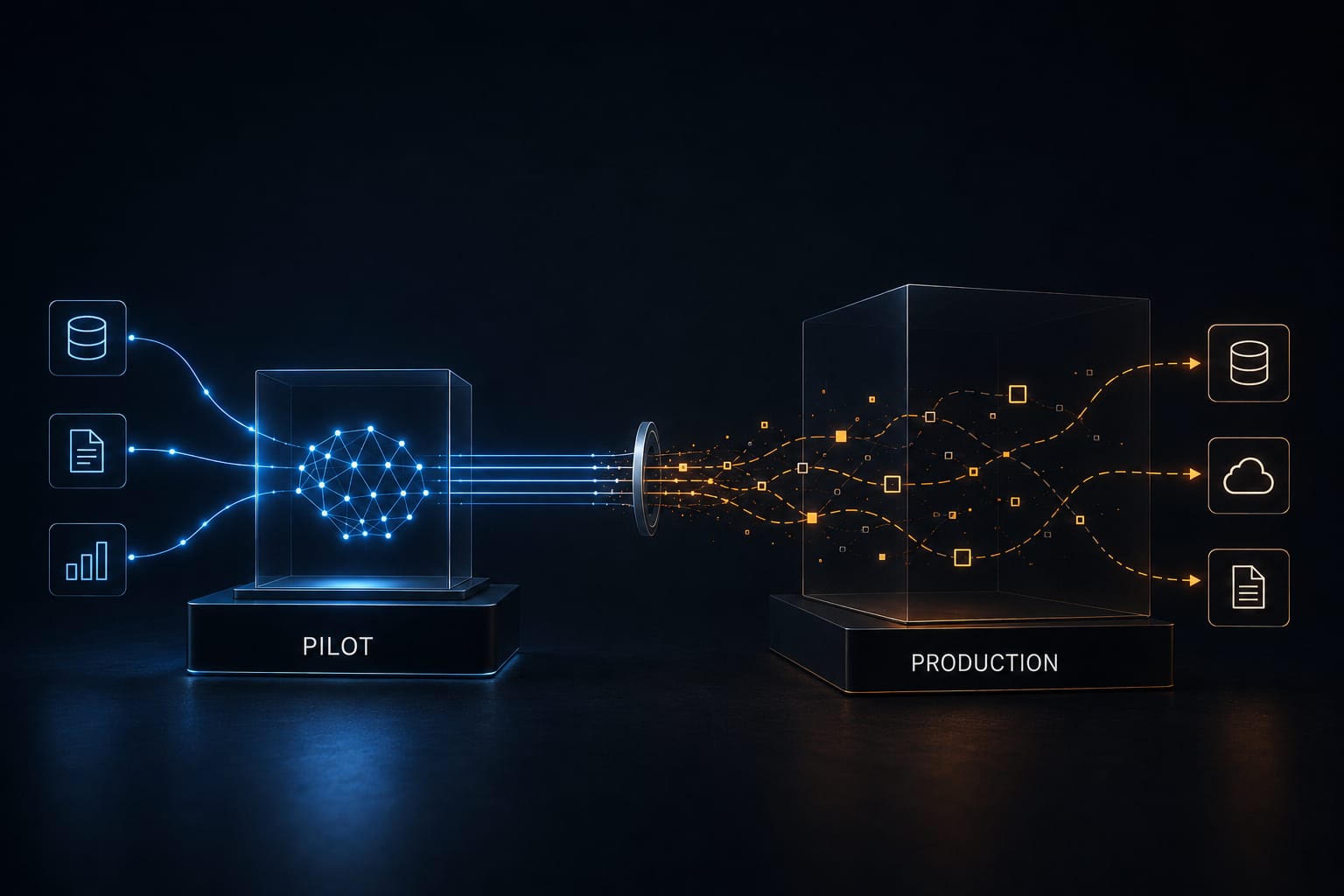
One of our partners recently shared a story with us.
Their customer had an AI project that worked well during the pilot. The model produced the expected results, the data looked right, and the project was ready to move into production.
Then the data started behaving differently.
Some information arrived late. Some feeds were incomplete. Data from connected systems didn’t always arrive in the format or at the time the production process expected.
The model hadn’t suddenly become worse. The path delivering data to it wasn’t ready for production.
It surfaced something easy to overlook in modern AI projects: secure and reliable file transfer still matters, even when the environment around it is built on AI, APIs, cloud platforms, and automation.
Why Does the Pilot Work and the Production Version Doesn’t?
A pilot can run on a dataset someone selected, cleaned, and prepared specifically for the test. Production has to deal with everything that happens after that.
A schema changes. A data feed arrives late. A partner system renames a field. A file arrives in a different format. A connection fails. A source system becomes temporarily unavailable.
The AI system still runs. But the information it receives may no longer represent the conditions under which the pilot was tested.
This is why moving AI from a demonstration environment into production is not simply a matter of deploying the same model at a larger scale. The data path has to work continuously as well.
Where Does the Project Actually Stall?
Often, the difficult part begins when the pilot needs access to real business data.
A sandbox can use test records. Production needs customer information, financial data, operational records, ERP data, CRM data, and files arriving from partners.
That immediately brings security and governance requirements into the project:
- Who is allowed to access the data?
- Which system is allowed to send it?
- How is the connection authenticated?
- Is the data encrypted while it moves?
- Can the organization prove what was transferred and when?
These questions are rarely as visible during a demonstration as they become when real data has to move between real systems. The AI project can therefore appear technically ready while the secure data pathway required to operate it is still being designed.
That is where timelines start to stretch.
What Does the Data Connection Need to Survive Production?
An AI system that retrieves information from an ERP, CRM, database, or partner system needs a connection that can already meet the organization’s security requirements.
That means the connection should:
- verify the identity of the specific endpoint it is communicating with;
- restrict access to the data the process actually requires;
- encrypt data before it moves between systems;
- remain reliable when transfers happen repeatedly;
- and create an auditable record of every exchange.
The same principles apply whether the transfer is initiated by a person, a scheduled process, an application, or an AI agent. The important part is that security should not depend on the person who happened to build the pilot. It should be part of the infrastructure the production system relies on.
Why Does Secure File Transfer Become Part of the AI Architecture?
AI systems increasingly depend on information coming from outside the model itself. A model may analyze customer records from an ERP, transaction data from a financial system, operational files from a supplier, or documents generated by another application.
The model is only one part of that chain. Data has to reach it. Results have to leave it.
Every one of those movements creates another connection that needs to be authenticated, protected, monitored, and auditable. This is where secure file transfer becomes more than a traditional IT function. It becomes part of the infrastructure that allows AI systems to operate reliably in production.
What Does This Mean for AI Projects?
The practical lesson is simple: treat the data pathway as part of the AI project from the beginning.
Before the pilot is approved, identify:
- Where does the data come from?
- How does it reach the AI system?
- Where do the outputs go?
- Which systems and partners are involved?
- How will every exchange be authenticated, encrypted, and recorded?
Building those answers after the pilot succeeds creates unnecessary pressure. Building them into the production architecture from the beginning makes the transition much more predictable.
Xferity is designed for this layer: secure, controlled file movement between the systems, applications, and partners that enterprise AI processes depend on. Connections are explicitly authenticated, transfers are encrypted, and every exchange creates an auditable record.
The goal isn’t to add another security step after the AI project is ready. It’s to make the path the AI depends on production-ready from the start.
So: Why Is Secure File Transfer Becoming Part of Every AI Strategy?
Because the question that determines whether an AI project can operate in production is bigger than the model. It’s also: Can the system reliably receive the data it needs and return what it produces through a connection the organization already trusts?
A successful pilot proves that the model can work with the right data under controlled conditions. Production requires something more: the right data has to keep reaching the right system, securely and consistently, every time.
That is why Managed File Transfer still has a role in modern AI environments. The surrounding technology may have changed, but the need for a reliable, controlled, and auditable path for data has not.
Before the next AI pilot gets its demo date, ask the question a production security review will ask sooner or later:
Where is this system’s data actually coming from - and would you already trust that path in production?